AI · Leak Scoper
AI Engine that Quantifies Leak Occurrence,
Location, and Scale as Probabilities
The AI Model is the Decision Layer of LMapper. By integrating and analyzing hydraulic flow data simulated by the Domain Model and field data collected by Smart Devices (UGV & Handy), it quantifies leak presence, location, and scale as probabilities. Using Flowork's proprietary Leak Scoper algorithm and Finite State Machine (FSM) architecture, it compensates for both data uncertainty and environmental noise.

Certification (KTL & KOLAS)
Detection accuracy, reproducibility, and environmental adaptability verified by accredited national testing institutions (KTL & KOLAS)

Field-Validated Data Training
High-reliability model trained on thousands of acoustic and flow datasets acquired from real-world demonstration environments

Hybrid AI + Physics Fusion
Combines Flow Scoper hydraulic analysis with AI signal processing for physics-informed decision-making

Environment-Adaptive Algorithm
Automatically compensates for variations in field conditions—such as road surface, temperature, and background noise—to maintain consistent performance across any site
Fusion
Multi-Source Data Fusion
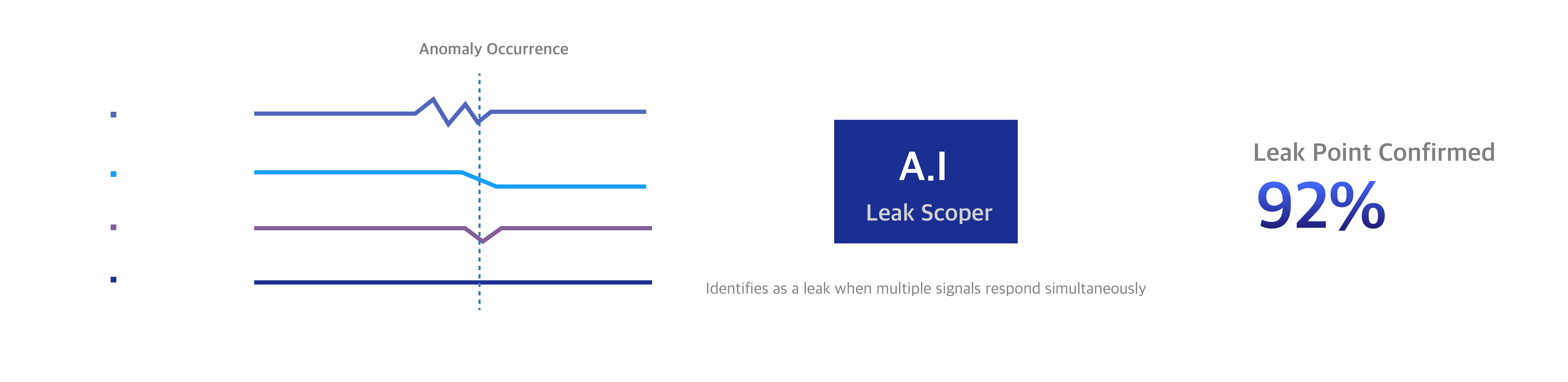
Multi-Source Data Fusion is an integrated analytics technology that spatiotemporally fuses acoustic signals, flow rate, water pressure, valve status, location information, and hydraulic simulation data generated by the Domain Model. By normalizing heterogeneous data with different physical properties and resolutions within a single analytical model and analyzing their cross-correlations, it achieves higher accuracy in anomaly detection and leak identification than single-sensor approaches. Furthermore, cross-validation across data sources minimizes environmental noise and measurement errors, providing highly reliable analysis results for network condition diagnostics, root cause analysis, impact range prediction, and operational decision-making.
Prediction
Probabilistic Leak Prediction
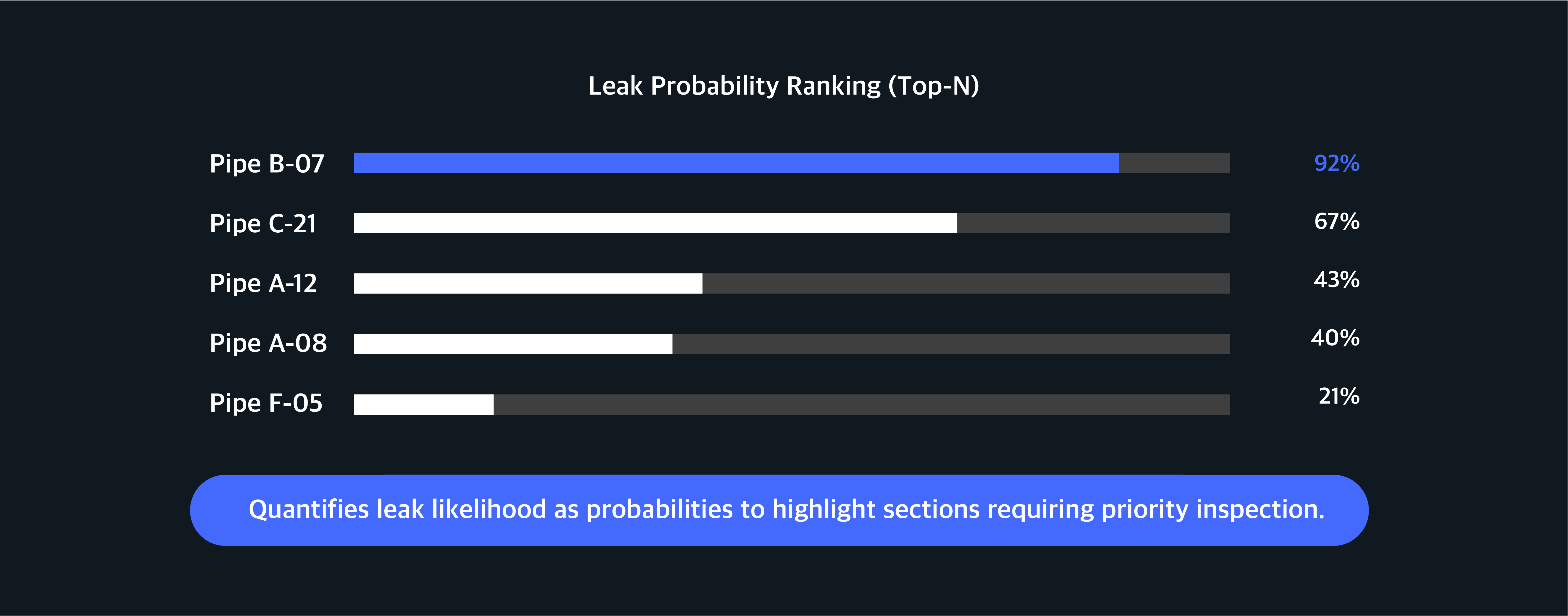
Probabilistic Leak Prediction is an AI forecasting technology that estimates the likelihood of leak occurrence using a probabilistic model based on multi-source data fusion results. By jointly considering the physical characteristics of the water network and real-time operational data, it calculates leak probabilities for each pipeline and section, expressing the predictions as a spatial Probability Map. Beyond simple detection, this supports risk-based maintenance and proactive operational strategy formulation—enabling efficient allocation of limited maintenance resources and minimizing operational risks.
Logic
FSM-Based Detection Logic
(Finite State Machine Logic)
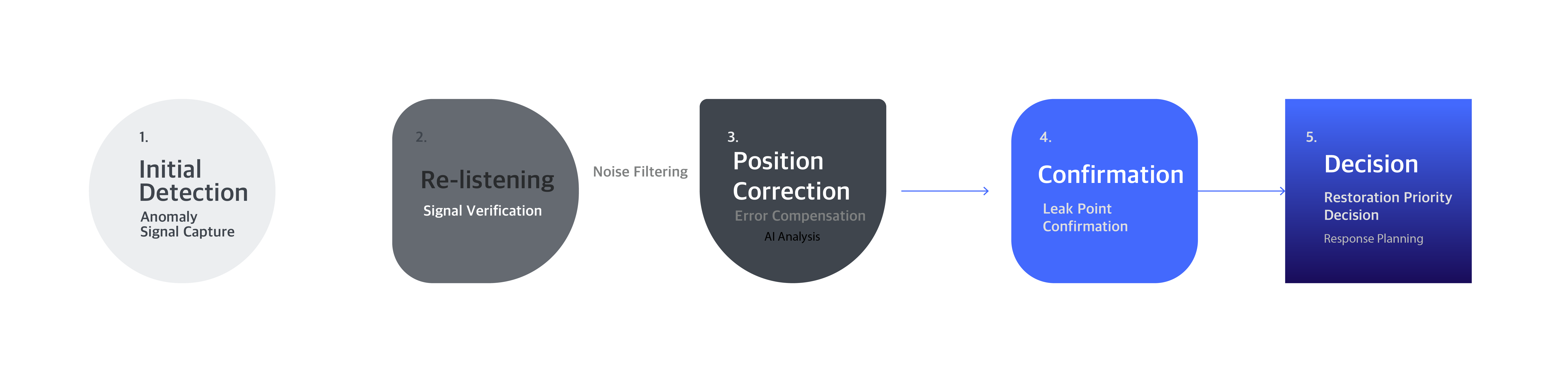
Finite State Machine (FSM) Logic is a decision-making structure that models the detection process as discrete States and Transitions. LMapper implements expert acoustic inspection procedures as an FSM—sequentially performing initial detection, re-listening, environmental noise compensation, AI analysis, and leak confirmation—to reduce data uncertainty and improve detection accuracy.
Learning
Self-Improving AI
(Continuous Learning & Self-Calibration)
Self-Improving AI is a self-learning AI technology that continuously feeds back actual measurement data and verification results generated during operations to optimize model parameters. By analyzing differences between actual leak detection outcomes and AI predictions, it iteratively calibrates the model and adapts to data distribution shifts caused by environmental changes, maintaining consistent predictive performance across diverse network conditions. In addition, it continuously enhances model generalization based on accumulated data to deliver highly reliable detection results even in new regions and varied operating environments.